Most teams plan in one tool, track readiness in a spreadsheet, run the night on a bridge call and write the closeout report by hand. CutoverStream is one platform for all four — built out of fifteen years of running them separately.
Each handover between tools is a rekey, and every rekey is a chance to be wrong. The reason the status report writes itself is that the runbook and the readiness grid are in the same place.
Ten scenarios, twenty-one plans, up to 197 tasks. Pick a go-live date and the schedule lays itself out around it. Program, project and cutover plans link and roll up.
Business areas against criteria composed from your program type, your industry and the regulatory regimes you carry. Eight compliance packs add the tasks each regime requires.
What is running, what is late, who owns it, whether you are inside the window — and the Go/No-Go recorded as it is taken.
Status reports generated from the plan. Overdue tasks emailed to each owner on a schedule. A complete audit trail underneath all of it.
Hypercare with an explicit exit rather than a fade. Lessons captured against the tasks that produced them, while people still remember. And the evidence a regulator or a post-mortem will ask for, already assembled.
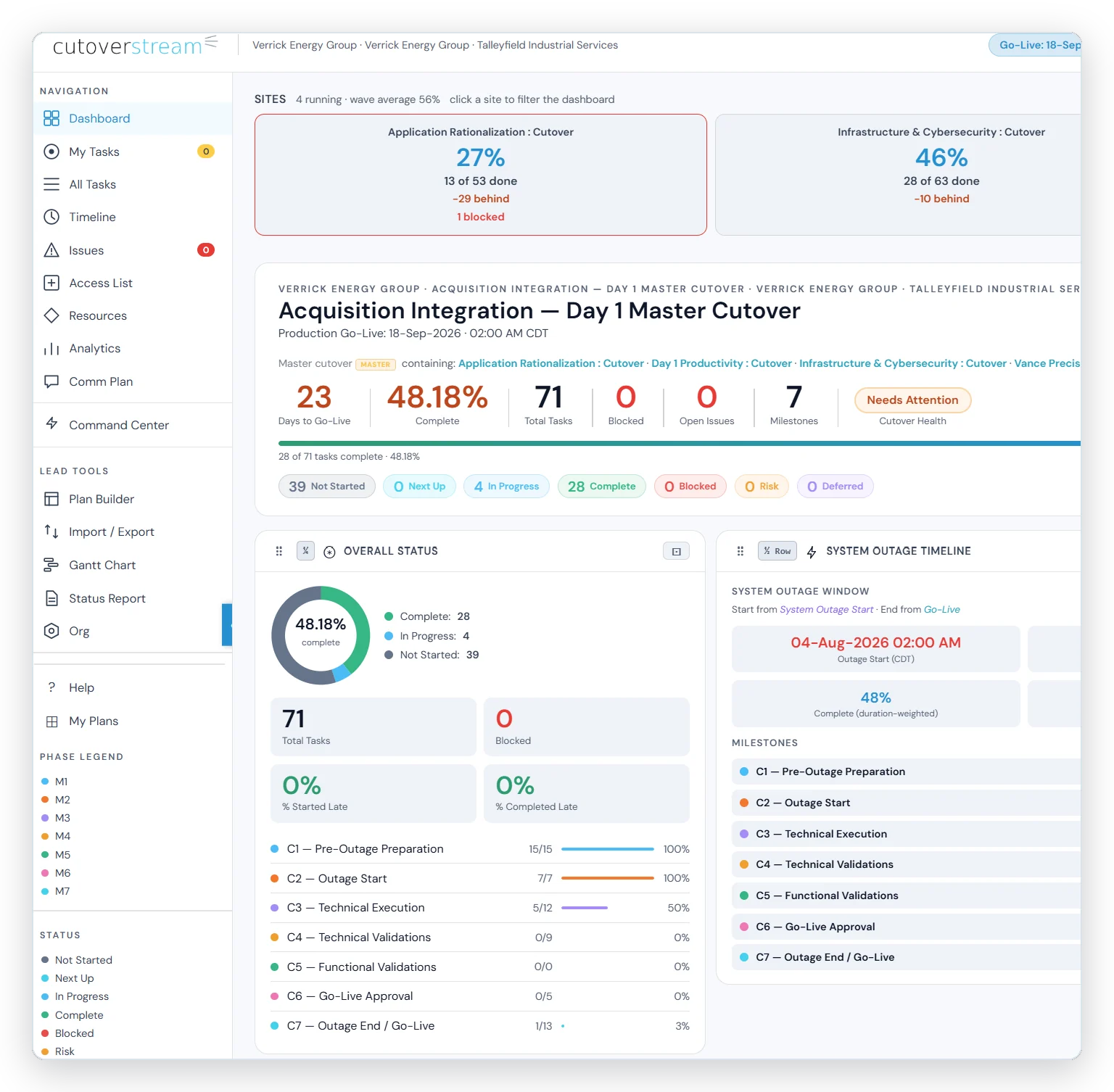
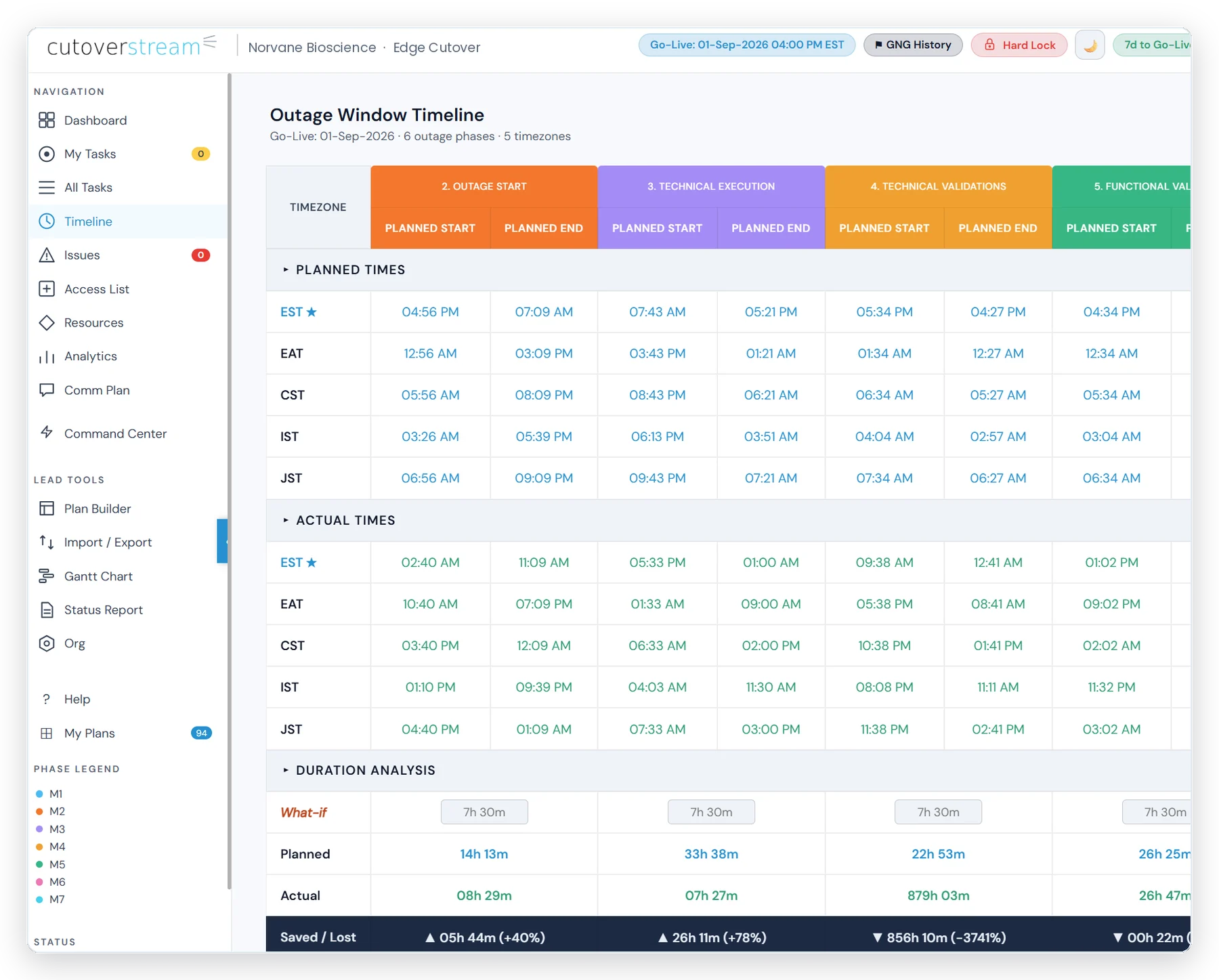
A cutover team is never in one timezone. The runbook runs on the wall clock where the work is happening; you see it in yours, without anyone doing arithmetic at 3am.
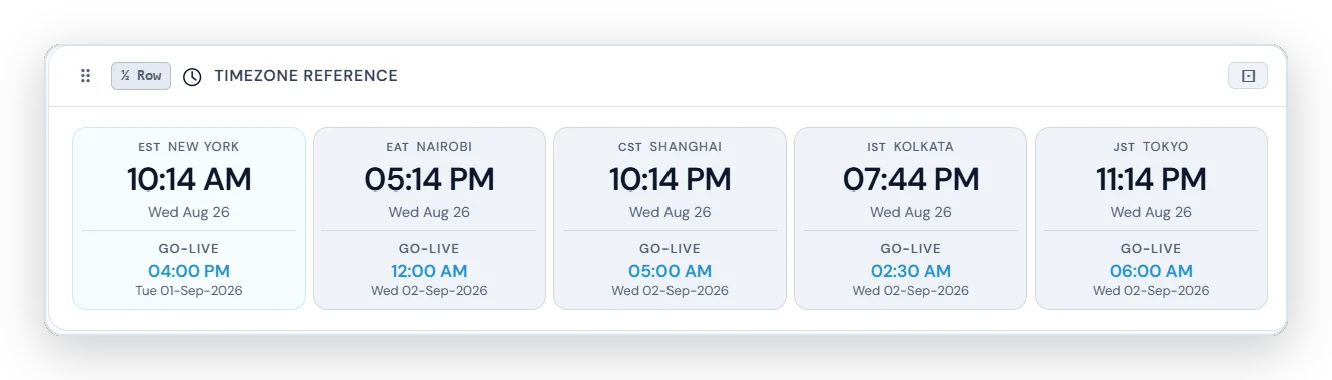
A Veeva RIMS implementation running across seven workstreams, one of several Veeva programs live at the company at the time. We were brought onto the RIMS cutover three weeks before go-live, with the plan in disarray.
Every workstream had its own cutover plan. Different formats, wildly different depth, no shared template. The master plan carried fewer than forty tasks against an implementation with integrations, data migrations and a regulated system underneath it.
We met each workstream, collected their tasks, and rebuilt the master plan on a template already proven across six implementations at the same company. As the tasks came into sync, the team came into sync. The plan was the first artifact that showed each workstream how its tasks depended on the others'. Blocked items were cleared in the daily scrum before they reached the timeline.
They were not short of capability. They were short of a plan that put everyone on the same page, sequenced to the minute.
Most teams run a cutover from a spreadsheet on a shared drive, read aloud on a bridge call. That works right up until it doesn't.
Twenty minutes, your program, your questions. We will show you the runbook and the command center — and you can tell us where it does not fit.
Request a walkthroughEverything below is in the product today unless it carries a roadmap tag.
A program holds many projects; each project ends in a cutover. Progress rolls up without anyone rekeying it into a deck. A Master Cutover Plan coordinates many cutovers in one window — one per project across a program, or one per location of a single project — each contributing to the master.
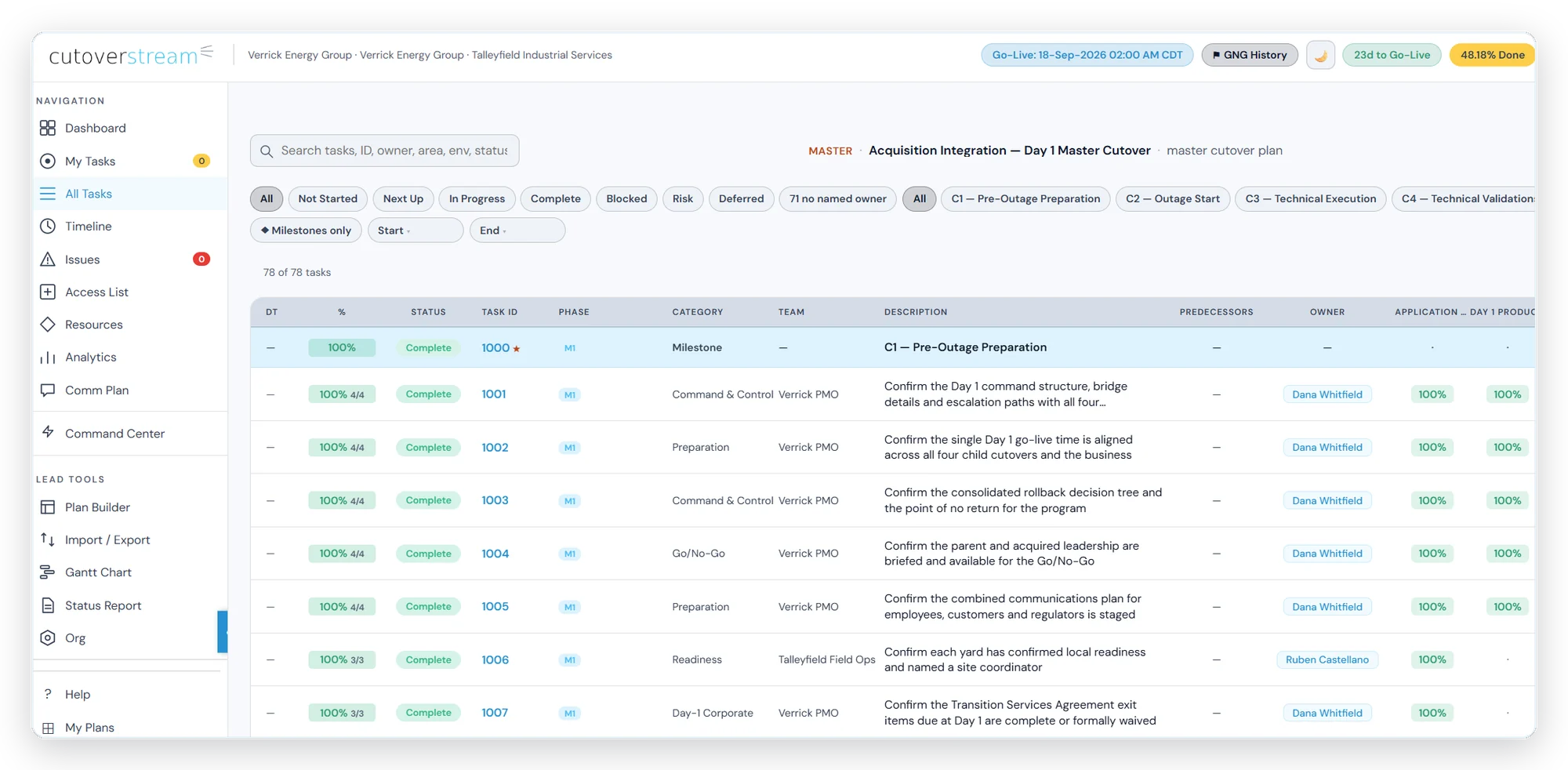
Ten scenarios and twenty-one plans, from an ERP go-live to an AI data center build at program, project and cutover level. Set the go-live date and every task lands where it belongs — long-lead items months out, the outage window hours wide.
Finance may be trained but working from unvalidated data. Supply Chain may be the reverse. A single "are we ready?" tick hides exactly the distinction the decision turns on.
Criteria are composed from three things — your program type, your industry, and the regimes you carry. They stack: acquire a medical device business and you inherit GxP on top of the SOX you already had.
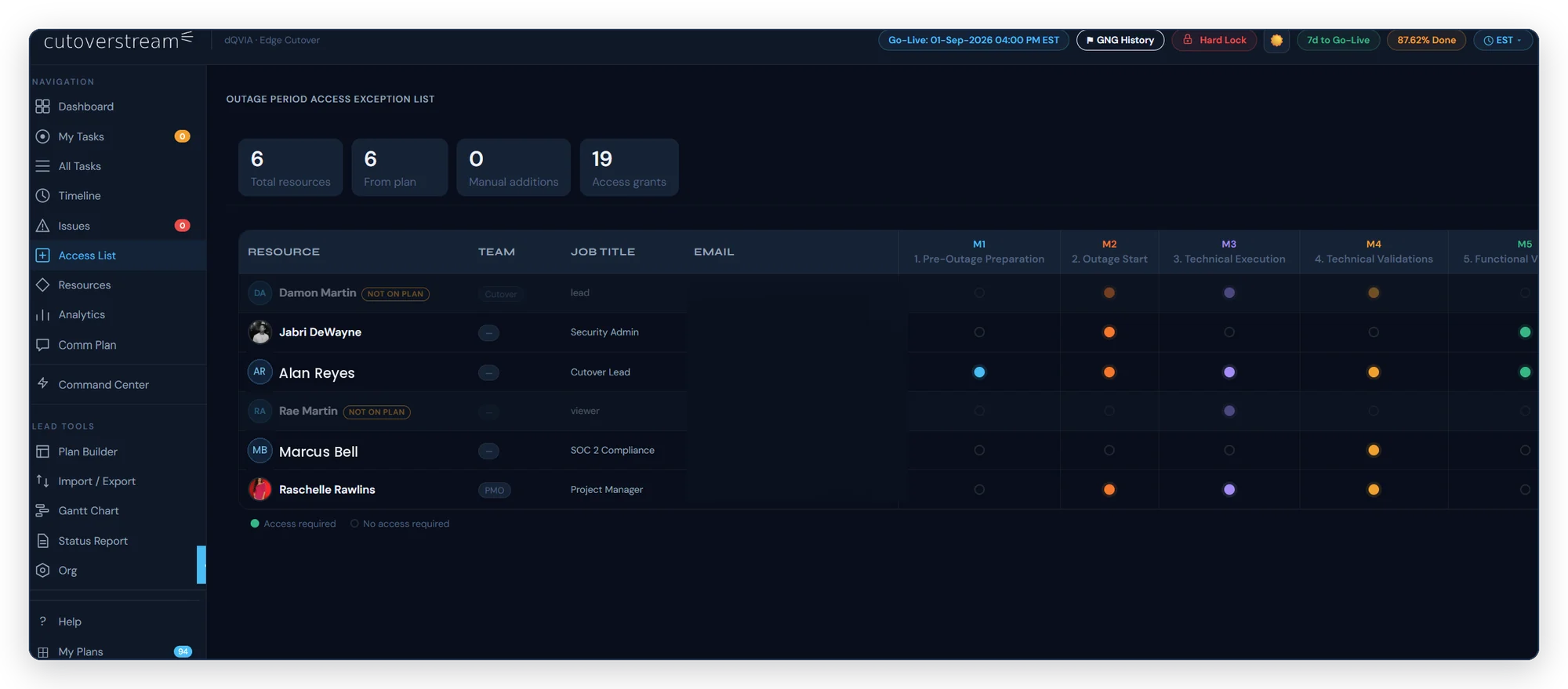
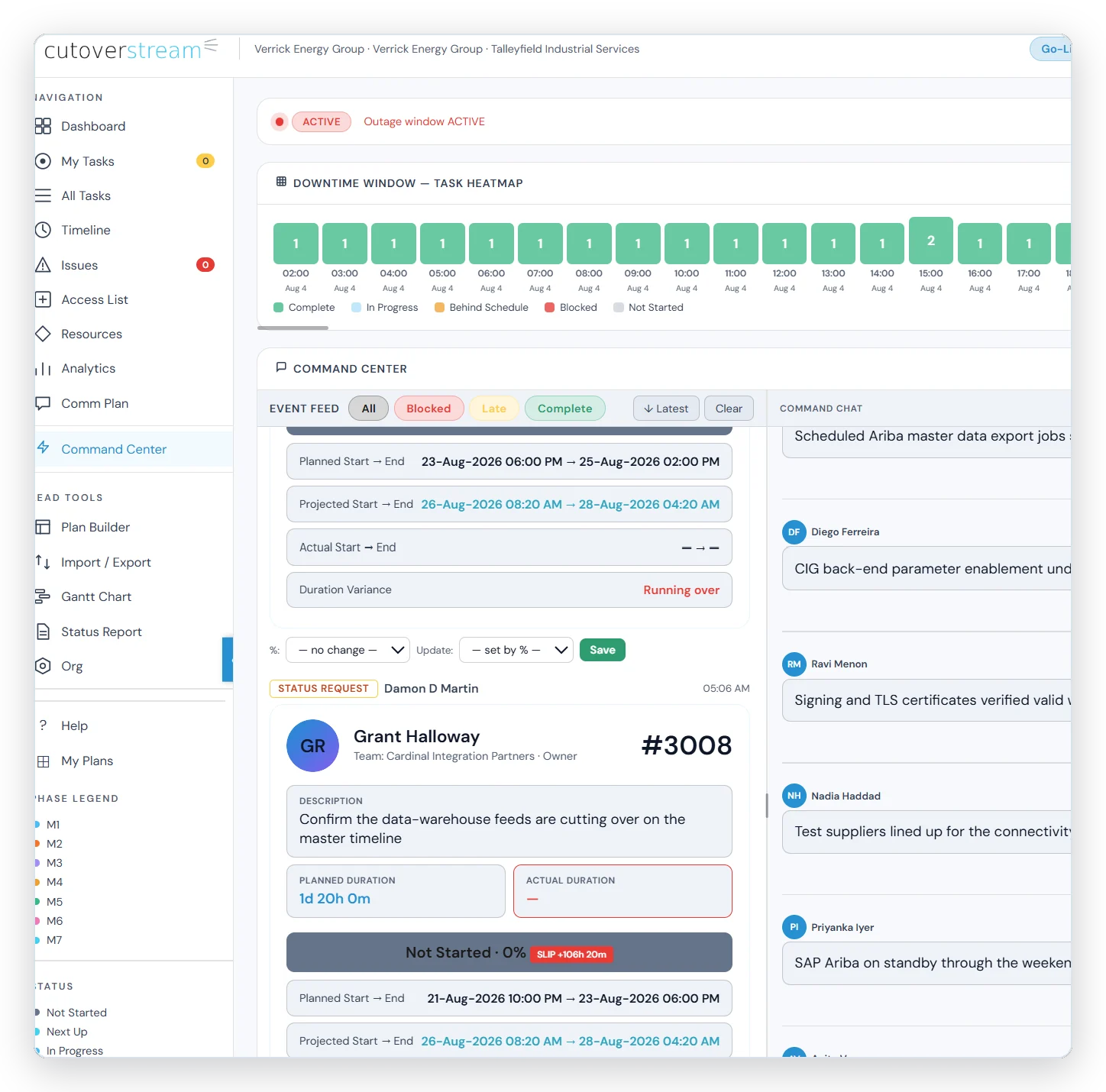
What is running right now and for how long. Whether you are inside the outage window or over it. Who owns the late one and whether they are awake.
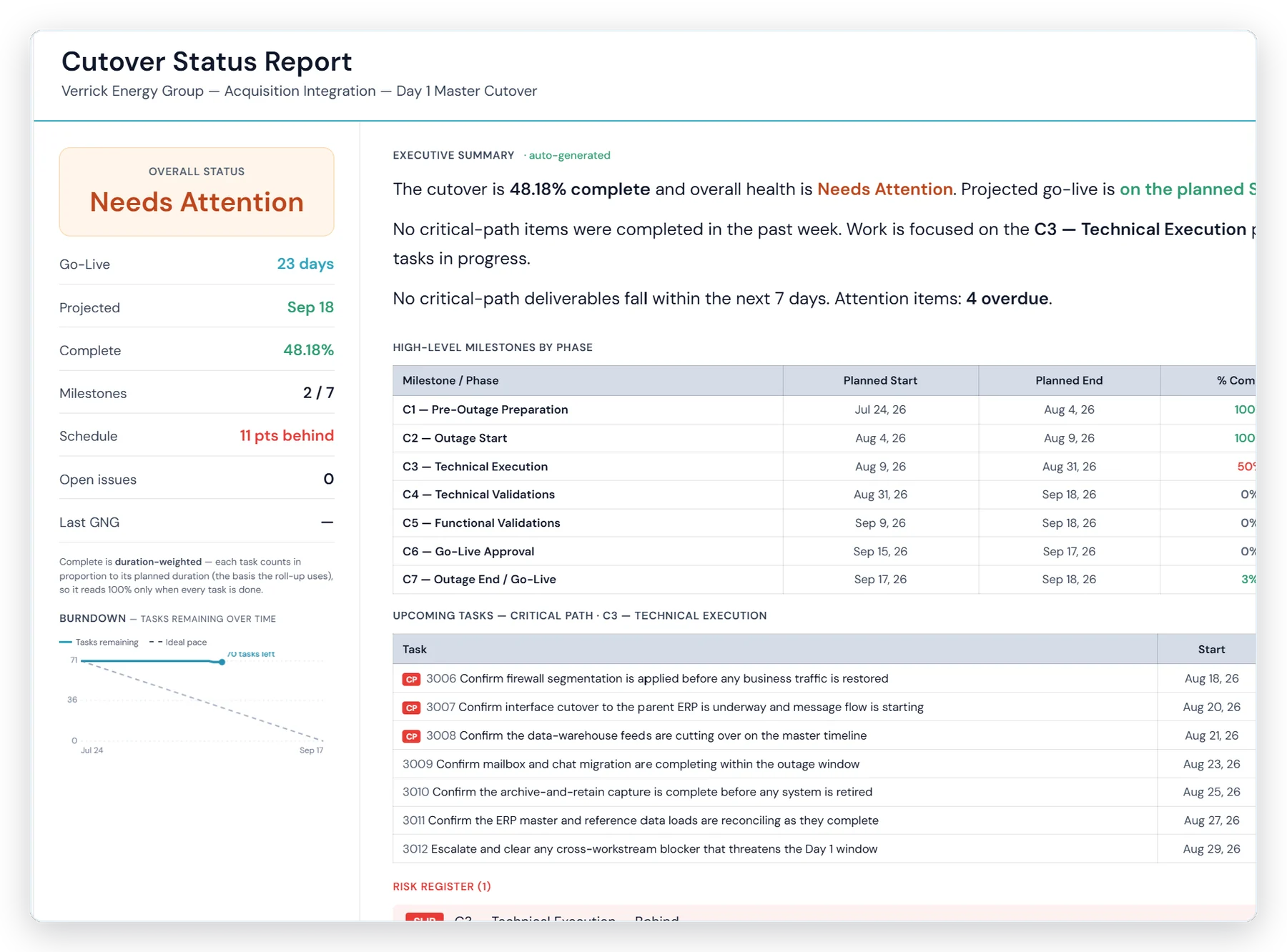
Duration-weighted progress against elapsed time, variance in words, and a per-milestone breakdown — generated from the plan, not typed on a Friday afternoon.
Every status change, date edit, approval and access grant — actor, timestamp and what changed. In a regulated go-live the evidence matters as much as the schedule.
Most programs end when people stop attending the call. A hypercare phase with stated stabilization criteria gives the program an actual end — and gives the sponsor something to sign.
Captured against the task that produced them, during the work — not reconstructed six weeks later from memory in a workshop nobody wants to attend.
Twenty minutes, your program, your questions.
Request a walkthroughCutover participation is bursty — two hundred people on the weekend, ten the rest of the month — and the platform is worth more the more of them are in it. Seat pricing would create an incentive to leave people out of the runbook, which is the exact failure this product exists to prevent.
| Capability | Starter | Professional | Team | Enterprise | Enterprise+ | Portfolio | Global Enterprise |
|---|---|---|---|---|---|---|---|
| Price | $199/mo · $1,990/yr | $449/mo · $4,490/yr | $1,199/mo · $11,990/yr | $2,499/mo · $24,990/yr | $5,499/mo · $54,990/yr | Contact salesannual, invoiced | Contact salesannual, invoiced |
| Concurrent plans | 1 | 3 | 5 | 12 | 20 | Unlimited | Unlimited |
| Users | Unlimited on every tier | ||||||
| Cutover plans & runbook | ✓ | ✓ | ✓ | ✓ | ✓ | ✓ | ✓ |
| Command center & real-time | ✓ | ✓ | ✓ | ✓ | ✓ | ✓ | ✓ |
| Downtime heatmap & Go/No-Go | ✓ | ✓ | ✓ | ✓ | ✓ | ✓ | ✓ |
| Timezone resources | ✓ | ✓ | ✓ | ✓ | ✓ | ✓ | ✓ |
| Templates & import | ✓ | ✓ | ✓ | ✓ | ✓ | ✓ | ✓ |
| Status report & exports | ✓ | ✓ | ✓ | ✓ | ✓ | ✓ | ✓ |
| Past due & due today email | ✓ | ✓ | ✓ | ✓ | ✓ | ✓ | ✓ |
| Audit trail | ✓ | ✓ | ✓ | ✓ | ✓ | ✓ | ✓ |
| Program plans & roll-up | — | — | +$750/mo | +$750/mo | ✓ | ✓ | ✓ |
| Multi-project cutovers | — | — | +$500/mo | ✓ | ✓ | ✓ | ✓ |
| Business readiness grid | — | ✓ | ✓ | ✓ | ✓ | ✓ | ✓ |
| Compliance packs 8 regimesGxP / CSV21 CFR Part 11SOX / ITGCHIPAAGDPRISO 27001PCI-DSSSOC 2 | +$950/mo | +$950/mo | +$950/mo | +$950/mo | ✓ | ✓ | ✓ |
| Advanced audit levels & tamper evidence | — | — | ✓ | ✓ | ✓ | ✓ | ✓ |
| SSO / SAML & org API keys | — | — | — | ✓ | ✓ | ✓ | ✓ |
| Travel & onsite matrix roadmap | — | — | — | ✓ | ✓ | ✓ | ✓ |
| Out-of-office calendar roadmap | — | — | — | ✓ | ✓ | ✓ | ✓ |
| Quality Plan module roadmap | — | — | +$600/project | +$600/project | +$600/project | +$600/project | ✓ |
| Multi-org portfolio governance roadmap | — | — | — | — | — | ✓ | ✓ |
| Data residency by region | — | — | — | — | — | — | ✓ |
| Named escalation & uptime SLA | — | — | — | — | quoted | quoted | ✓ |
| Cutover delivery services | — | — | — | — | quoted | quoted | quoted |
| Subscribe to Starter | Subscribe to Professional | Subscribe to Team | Subscribe to Enterprise | Request an invoice | Talk to sales | Talk to sales | |
| Billing | Card | Card | Card | Card | Invoice + PO | Annual, invoiced | Annual, invoiced |
Program plans and roll-up across projects. Included at Enterprise+ and above — and available as an add-on on Team and Enterprise for an org that needs program coordination without moving up a tier.
Coordinate many cutovers under one Master Cutover Plan for a go-live window — one per project across a program, or one per location of a single project — with a column per cutover on the master. Included at Enterprise and above; available as an add-on on Team.
All eight regimes as one bundle. Applying a pack adds the tasks that regime requires to your plan — project-side activities on a project plan, cutover-night ones on a cutover plan. Included at Enterprise+ and above.
A separate module: quality requirements with owners and acceptance criteria, phase gates, evidence attachments and QA sign-off, with its own dashboard and status report. Included with Global Enterprise.
Every scenario ships a cutover plan; most ship a matching project plan, and the AI data center build ships all three levels. Set a go-live date and the schedule lays itself out.
Apply a pack and the tasks it requires are added to your plan — project-side activities on a project plan, cutover-night ones on a cutover plan. Not a checklist bolted on the side.
| Pack | What it adds | Project | Cutover |
|---|---|---|---|
| GxP / CSV | Validation lifecycle, IQ/OQ/PQ evidence, QA release approval without which production use does not begin | 27 | 14 |
| 21 CFR Part 11 | E-signature verification, audit-trail continuity confirmed before the first business transaction | 16 | 8 |
| SOX / ITGC | Segregation of duties verified in production roles, change-management evidence, privileged access log | 13 | 9 |
| HIPAA | PHI handling, access controls, breach-notification readiness | — | 8 |
| GDPR | Data-subject rights, lawful basis, cross-border transfer checks | — | 8 |
| ISO 27001 | Control evidence, risk treatment, time synchronisation | — | 8 |
| PCI-DSS | Cardholder data scope confirmed, leak detection, network segmentation | — | 8 |
| SOC 2 | Trust services criteria mapped to cutover activities | — | 6 |
Everything on this page is planned rather than shipped. It is here because you are buying a direction as much as a product — and because finding out later is worse.
Which days each person must be onsite, grouped by team, with location and arrival. A cutover weekend has people flying in; today that lives in a separate spreadsheet.
Planned absence visible against the plan, so a task is not assigned to someone who is away the week it falls due.
Quality requirements with owners, due dates, attachments and phase gates, with its own dashboard and status report. The first per-project paid module.
A parent organization that sees every cutover across its business units without any of them seeing each other. Central policy pushed down, consolidated audit export, data residency per region, SSO and SCIM at group level.
Save any plan as a template inside your organization and start new projects from your own runbook structure rather than ours.
An external reference on a task and an outbound webhook, so a cutover step can open and close a ticket in the system your operations team already lives in.
A program, not a price tier. You run cutovers for other companies — usually inside their tenant, one client at a time — and that is a different shape from a customer running a portfolio of their own.
In a regulated cutover the client must own the GxP records, the Go/No-Go decisions and the approver signatures. An integrator cannot hold that on the client's behalf. Whoever owns the evidence owns the license — which means you are never the reason a customer has to migrate their audit trail when an engagement ends.
You buy at wholesale, set your own client price, own the relationship, the margin and the collection risk. Suits firms who want the platform inside their own delivery offering.
The client contracts with us at list; you take a recurring share and carry no balance-sheet exposure. Suits firms who would rather not invoice for software.
Your own tenancy at Team or Enterprise for building runbooks before a client engagement starts.
Your cutover leads trained and certified on the platform, listed as accredited.
Joint pursuit where the client is buying delivery and platform together.
Tell us how you deliver and we will tell you which model fits.
Contact the partner teamA group transformation office running cutovers across business units that each operate as their own tenant — with their own regulators, their own data residency and their own auditors.
Unlimited plans and users. Every cutover in flight across all business units in one view, without any child organization seeing another's data. Compliance packs, readiness axes and templates set once at group level and inherited. Consolidated audit export for a group-level audit rather than eleven separate ones.
Portfolio, plus data residency per region so an EU subsidiary's records stay in the EU, SSO and SCIM at parent level, an uptime SLA with named escalation, and the Quality Plan module included.
Tell us how many business units, which regions and which regulators, and we will put a number against it.
Talk to sales